Why Fabrika
Built to deliver production-ready code
- Red and blue teams at every stage Builders and checkers on different model lineages. The spec, the plan and the code are each attacked before you see them. The crew
- Blind tests The oracle writes acceptance tests from the spec alone and never sees the implementation, so a pass means the contract was met. The build
- Sealed isolation Every agent and every check runs in its own container and worktree, with no route to your machine. Your checkout is never touched. Isolation
- Integrated supply chain management Every new dependency is screened with OSV for vulnerabilities and malicious packages, for license problems, and for releases only days old. Dependencies
- Built-in best-practice guidance It surveys how your repository is linted, typed, tested and guided, proposes what is missing, and writes the small fixes itself. Repo ready
Optimized for human decisions
- Visual spec review What the change touches, drawn as a diagram, and every criterion with how it will be verified and how hard it would be to undo. Spec review
- Context-enriched code review Code reached through the criterion that asked for it, beside the decisions and objections behind it, instead of a diff read from the top. Work map
- Recorded evidence of success The project’s own checks, blind tests, breaker probes and recordings of browser tests, all kept in the packet. Evidence
- Codebase discovery The as-built: an architecture, subsystems and capabilities, read from every file in the repository and kept current. As-built
Fabrika vs
Your Favorite Coding Harness
A harness can do every step. A factory makes sure it does.
Your harness can spin up subagents, write tests and check its own work. Whether it will, and whether it will do it the same way twice, is up to the session.
Fabrika fixes the line instead. The flow is prescribed rather than configurable, which is what lets it guarantee red-teaming, blind tests and the project’s own checks on every feature, with plain code deciding what runs next.
Builders and checkers, on different model lineages.
Every station is an agent with one job and one prompt. Builders make things; checkers attack what was made. Fabrika wants the two teams on different model families: for example, build with Claude, check with GPT or Gemini.
Each agent sees what its job needs
A worker gets the whole branch and every tool the harness has. The oracle gets the requirements and none of the code.
Models matched to the job
A scout that reads and summarizes code can run on something like Haiku; the architect that plans the build needs something like Opus.
Prompts you can read and change
Each role is a Markdown prompt loaded at call time, tuned for its station and editable in the console.
Repo ready: Approve the checks
Point Fabrika at a repository and it surveys how
the code is already checked, tested and guided:
linters and type checkers, security and
accessibility checks, unit, integration and
user-facing tests, and agent guides like AGENTS.md and CLAUDE.md.
Every check it finds runs on an untouched checkout. Nothing is built until you accept them, because every later feature is judged against that baseline. A check does not have to be green to be accepted: fix it, hold it at today’s number, or rule that it does not apply.
Spec review: Freeze the spec
Give it a prompt and a name. The scout reads the codebase, and the interrogator asks what reading could not settle. Then a spec writer drafts and a spec checker scrutinizes; only the disagreements they cannot settle reach you, as open questions.
Every spec follows one outline, so you know where to look:
- 06 How this was decided
Each criterion says how it will be verified, at which level, and how hard it would be to undo, from easily changed to cannot be undone . The oracle writes its tests against exactly these. Nothing is built against a spec you have not frozen.
The build:
watch,
don’t steer.
The architect plans the units of work and a plan checker objects; you see the plan, at plan review, only if they cannot agree. After that there is no input mid-run.
Two lanes run blind to each other: workers build while the oracle writes tests from the spec. Running the checks, running the oracle’s tests and splitting repairs into non-overlapping units is done by plain code, not by an agent.
| Station | Team | What it does |
|---|---|---|
| worker | builder | Writes the code and its unit tests. Several run in parallel, each in its own unit of the plan. |
| integrator | builder | Joins the workers’ units into one whole, and writes the tests that cover the seams between them. |
| oracle | checker | Writes acceptance tests from the spec alone, in parallel with the workers. It never sees the implementation. |
| breaker | checker | Attacks the result: boundaries, failure paths, concurrency, hostile input, criteria met in letter but not in spirit. It writes probes that fail to prove it. |
| reviewer | checker | Makes the strongest case against shipping: duplication, broken conventions, unearned abstractions. |
| arbiter | neither | Rules on every finding: repair it, simplify it, send it back to the oracle, rule it out of scope, or escalate it to you. It cannot make a finding disappear. |
| repairer | builder | Makes the narrowest fix for what the arbiter sent back, in a loop bounded by rounds, budget and wall clock. |
| simplifier | builder | Simplifies code that is correct but more complicated than it needs to be. Everything is re-tested afterwards. |
| rapporteur | neither | Assembles the review packet. |
Feature review: Rule on the packet
What comes back is not a pull request. It is a review packet: the code, plus a structured argument that it does what was specified. Code is reached through the criterion that asked for it. You audit the argument and rule on a handful of decisions, instead of reading a diff from the top.
The outcome is either a branch you can merge, or another round of work.
The decisions the run could not settle on its own: findings that were escalated or could not be repaired, and anything you need to check by hand. Each one carries the arbiter’s reasoning and the evidence behind it, and you repair or dismiss it with a reason.
Every acceptance criterion drawn against the files written for it, sorted into four kinds. Novel code, the files with real choices in them, is split from boilerplate you can safely skip. When in doubt, a file is marked novel.
Everything the run produced that you can check for yourself: the project’s own gates, the oracle’s blind acceptance tests, the breaker’s probes, and video recordings of browser tests. Each section ends by saying what it does not prove.
Every package the change brings in, checked against OSV for known vulnerabilities and malicious releases, against the project’s license rules, and for releases published only days ago. Anything flagged becomes a call for you.
Every objection raised about the change, grouped by what the repair loop did about it. An objection the loop fixed stays in the list with its outcome beside it: a packet that got shorter as the loop worked would look better and be worth less.
The details of each repair round. Repairers make the narrowest fix for what the arbiter sent them, and the loop is bounded by config: by default two rounds, a dollar budget and a wall-clock limit.
The places where the packet’s numbers look better than the evidence behind them, listed so you know which green numbers not to take at their word.
As-built:
the codebase,
read file by file.
You need a mental model of a system before you change it. A reader agent reads every file, plain code checks what it reported and joins it into a graph, and a cartographer names the groups. The result is an architecture, a set of subsystems and a map of capabilities, each with a stable three-letter id.
It runs whenever you ask, and afterwards reads only the files that changed since the last commit it processed.
Three skins,
one board.
The console comes in default, day and night, switched from the masthead and remembered by your browser. A skin moves one ground onto the other rather than inverting the page: in day the board joins the floor, in night the floor joins the board.
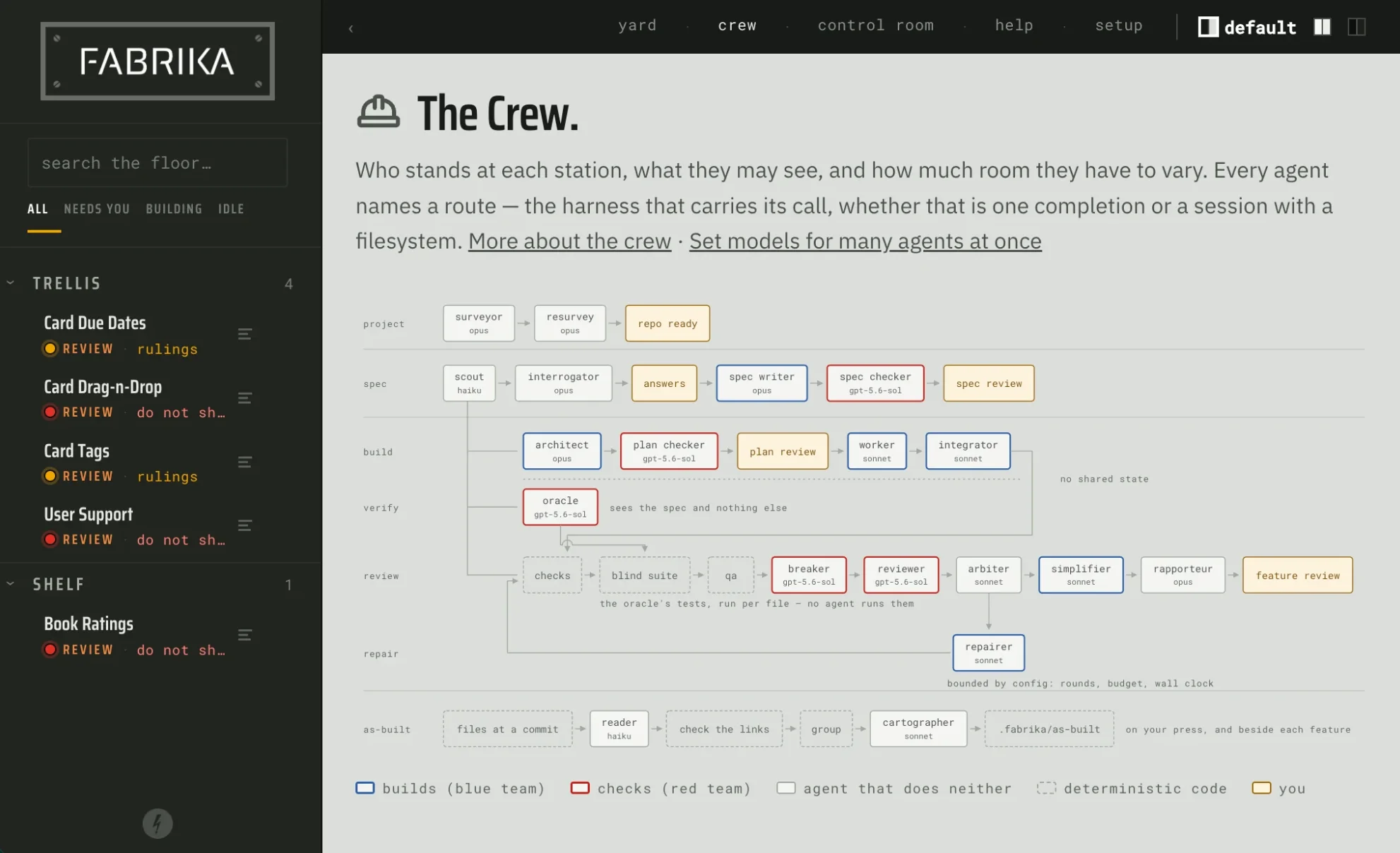
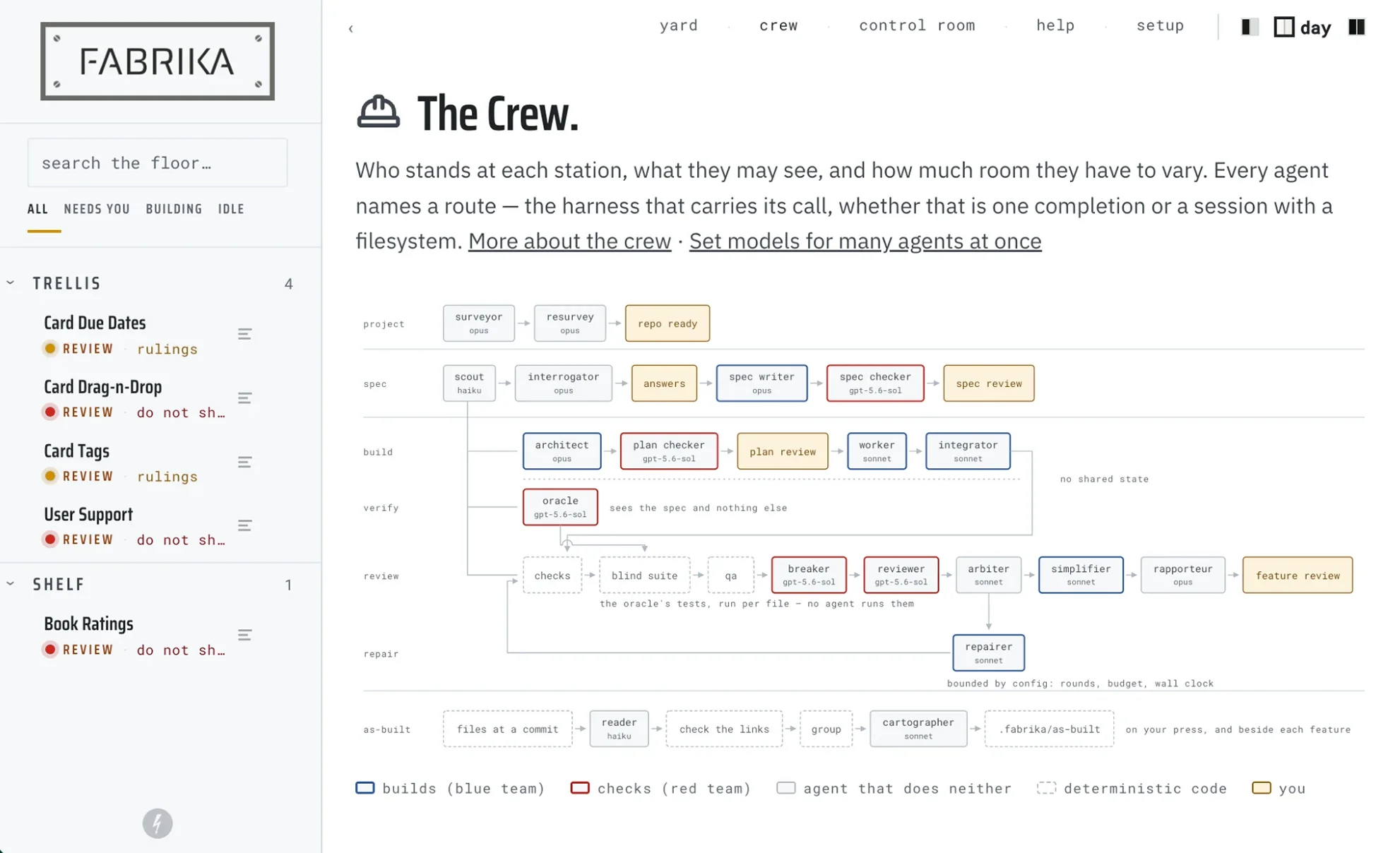
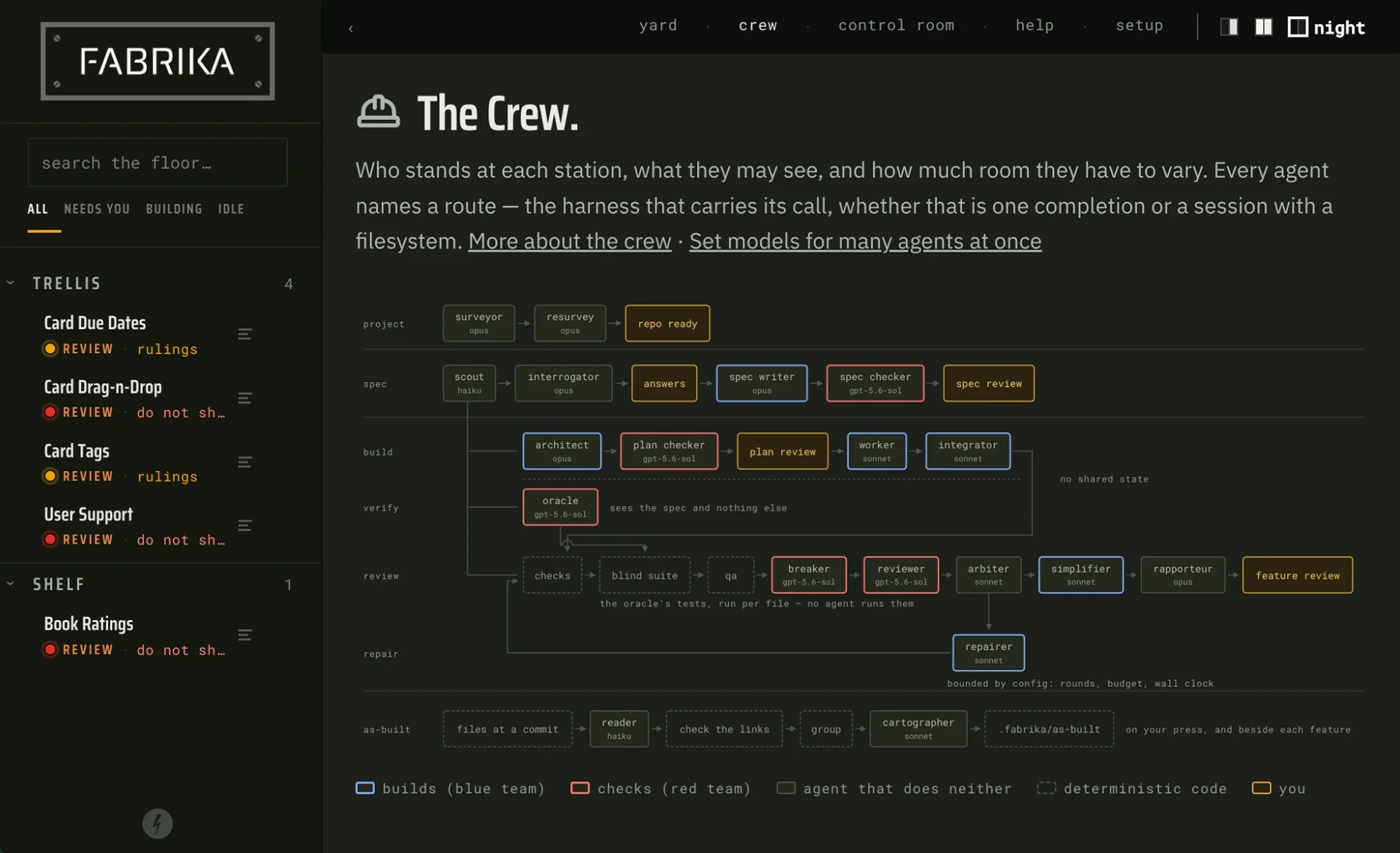
default The enamel board and its rail hang over a painted floor; the record is read on the floor.
Runs on the subscriptions you already have.
Fabrika drives Claude Code and Codex headlessly, on your Anthropic and OpenAI subscriptions. Anything OpenAI-compatible, OpenRouter or a model on your own machine, runs through the OpenHands harness.
Subscriptions get throttled, so each team has a
fallback agent the factory switches to when its
main route says no. Every model name lives in
one file, factory.yaml.
What it is for, and what it is not.
Built for
- One person, or a small team, building features largely on their own.
- Well-defined, self-contained features, designed before they reach the factory.
- Running on your own machine, as a single user.
Not yet, or not at all
- Team logins, coordinating work streams, cloud deployment.
- Work that needs a lot of back and forth, like shaping a user experience or exploring a problem space. Use an interactive agent session for that.
Where it stands
Alpha, version 0.1.0, MIT licensed. It has not been used in anger yet, and it will have bugs. About twelve hundred tests each assert a property that makes it worth running: the invariants, isolation, the repair loop, what the console draws.